Real Story · Mature Skin
How A Boardroom Whisper Almost Ended My Career At 53
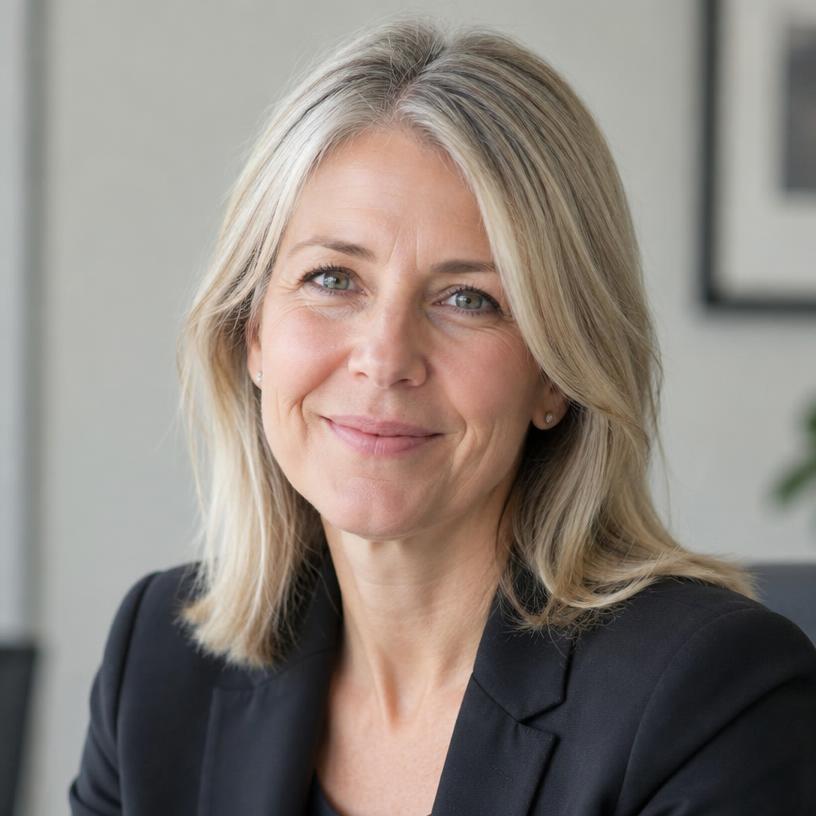
By Karen M.
Senior VP, healthcare · Charlotte, NC
My CEO pulled me aside after the meeting. “Are you still with us on this?”
I was. Completely. I’d been nodding the entire hour.
He’d read my face as disapproval.
My name is Karen. I’m a senior VP at a healthcare company outside Charlotte. I’ve spent thirty years building this career. And in the span of about eighteen months, I almost lost all of it — not because my work slipped, but because my face started lying about me.
If you’re a woman over 45 and people keep asking if you’re tired, upset, or okay when you’re fine — please read this. What I’m about to share is the thing I wish someone had told me two years ago.
The Problem Nobody Warned Me About
Adults form judgments about mood, competence, and approachability in under 100 milliseconds — before you speak a single word.
For a professional woman in her fifties, that’s terrifying.
Because somewhere around 51, my resting face changed. Not dramatically. Not overnight. But enough that people started reading me wrong.
My assistant asked if she’d upset me. I was reading an email.
My best friend of thirty years texted after brunch to ask if she’d said something wrong. She hadn’t.
My son called from college and started with, “You sound weird, are you okay?” I’d said hello.
And then the board meeting.
I sat there composed and engaged. I nodded. I took notes. And my CEO pulled me aside afterward and asked, gently, if I was “still on board with the direction.”
I was on board. I’d never left. But my face had already voted no.
The 3 AM Realization That Broke Me
I got home from that meeting and I could not sleep.
I sat at my kitchen island at 3 AM with a cup of tea I never drank. And I did the math.
Thirty years of building credibility. Thirty years of learning to control my voice, my email tone, my body language, every professional signal I could think of. And now my own face was undoing all of it.
I looked exhausted when I wasn’t. I looked sad when I was fine. I looked disappointed when I was listening intently.
The corners of my mouth had started turning down at rest. There were shadows under my eyes that concealer couldn’t fix. My forehead had softened in a way that made me look worried, even when I was calm.
I was performing “not upset” full-time. My cheeks ached by the end of every Zoom call from smiling harder than necessary. I was exhausted from a problem I couldn’t name.
What I Tried First (And Why It All Failed)
I did what every woman does. I threw money at it.
- More sleep. I got eight hours. My face still looked tired.
- Better skincare. A seven-step routine that took twenty-two minutes every night. Nothing changed in the mirror.
- Collagen powder in my coffee. Six months. No difference.
- The “good” foundations. $340 in one afternoon at Sephora. Chanel. Lancôme. Charlotte Tilbury. All of them.
Every single one made it worse.
By 2 PM, my expensive foundation had settled into every line around my mouth. It pooled in the hollows under my eyes and made the shadows darker. It sank into the little downturns at the corners of my lips and outlined them like a marker.
I looked older with makeup than without it.
I sat on the closed toilet lid at 11:47 PM with a makeup wipe in my hand, and I thought: maybe this is just my face now. That was rock bottom. Quiet. Flat. Done.
The Dinner Party Comment That Changed Everything
Six weeks later, I was at a small dinner party. I overheard a woman — probably sixty, elegant, retired from film production — explaining something to another guest.
She said that most foundations are engineered to sit on top of skin like a coat of paint. On younger, taut skin, that works fine — because smooth skin under a layer of pigment still reads as skin.
But once skin loses some of its water content and develops more texture — more lines, more soft creases, more topography — a layer of pigment on top of that texture doesn’t hide it. It highlights it.
Every fine line becomes a place where pigment pools. Every dry patch becomes visible. Every crease around your mouth gets outlined by the very foundation you’re using to cover it.
I sat there holding a glass of wine and felt something crack open in my chest. Because that was the exact reason my face was betraying me. I hadn’t been covering my face. I’d been drawing attention to every feature that was working against me.
The Missing 1% Nobody Talks About
Here’s what 99% of women know: as you age, you need “better” foundation. Here’s the missing 1%: it’s not about better. It’s about differently formulated.
Conventional foundation is built to sit on skin. Pigment plus a film-forming agent, layered on top of the surface. That formula assumes the surface underneath is smooth, hydrated, and plump.
Mature skin isn’t any of those things anymore. Not because there’s anything wrong with it — but because after about 45, skin holds less water, produces less of the peptides that keep it firm, and develops the natural texture of a life well lived.
So the fix isn’t more coverage. The fix is a foundation that treats the underlying skin at the same time it evens the surface. A completely different category of product.
30-day money-back guarantee · Free shipping on multi-packs
What I Found (And Who Told Me About It)
I asked a professional makeup artist I know — a woman who works specifically with clients in their fifties and sixties for on-camera work. She told me the industry has quietly shifted. There’s a small group of formulas now designed around the actual biology of mature skin instead of retrofitting a twenty-year-old formulation and slapping “mature” on the box.
She recommended one specifically. Elarisse Foundation for Mature Skin.
What made me actually try it was reading the ingredient list.
Hyaluronic acid
Holds up to a thousand times its weight in water, so the formula plumps a crease from underneath instead of settling into it.
Niacinamide
Clinically shown to improve skin tone, soften the look of discoloration, and strengthen the skin barrier over time.
Peptides
Small protein chains that support the skin's own firmness — so every hour of wear supports your skin, not just conceals it.
Elarisse was $34.95. Less than half of what I’d been spending on foundations that made me look older. I was skeptical. I’d been skeptical about everything for eighteen months. I ordered it anyway. I had nothing left to lose.
What Happened Next
The first morning I wore it, my husband asked if I’d slept better. I hadn’t. I’d slept my usual six hours.
The next Tuesday, in my weekly meeting, nobody asked if I was okay. Nobody. For the first time in over a year.
The week after that, my best friend said, “You look really rested” — and I’d been up until midnight on a deadline the night before.
My assistant stopped checking in on my mood. I sat through an entire board meeting and my CEO never once pulled me aside.
What This Actually Gave Me Back
I want to be honest about what changed. Because it wasn’t cosmetic. Not really.
I got my meetings back. I stopped worrying that my face was voting against me while I spoke. I got my brunches back. I stopped noticing my friends checking my expression. I got my Zoom calls back. I stopped bracing every time I saw myself in the little corner window.
I got the mental space back that I’d been spending on “performing not-upset” all day, every day. At $34.95, it’s the best money I’ve spent on my face in ten years.
Why I’m Writing This
I’m not a beauty influencer. I’m a fifty-three-year-old operations executive who almost lost her professional footing because nobody told her the real reason her foundation was making things worse.
If you’re a professional woman over 45 and people keep misreading your face — please, at least look into this.
Elarisse offers a 30-day money-back guarantee, which is what finally pushed me to click order. If it hadn’t worked on my face, I’d have sent it back and been out nothing. Instead, I’ve reordered three times.
You have two choices, and I’ve lived both.
You can keep performing “not upset” for the rest of your career. You can keep spending $80 to $100 on foundations that make things worse. You can keep bracing every time someone asks if you’re okay.
Or you can spend $34.95, take 30 days to see what your face looks like on a formula that was actually built for it, and find out — the way I finally did — that it was never your face. It was the formula.
I wish I’d known at 51. I hope you know sooner.
30-day money-back guarantee · Free shipping on multi-packs